Bullet points done well, with rules for wording, punctuation and when to skip them
A bullet point is a promise to the reader. It says this item stands on its own, and you can take it in at a glance. When that promise holds, lists save people time. When it breaks, a list feels like a pile of notes someone forgot to finish.
This guide covers when a list is the right choice, how to word the items so they match, why each bullet should carry one idea, and how to handle capitals and end marks. It closes with two conversions, one dense paragraph turned into bullets and one list turned back into prose.
When a list beats a paragraph
Use bullets when the items are separate and roughly equal. Good candidates include steps in a process, things to bring, features of a plan, or options a reader will compare.
A list also helps when people will come back to the text later. A packing list, a set of meeting actions or a checklist of documents gets read more than once, and bullets let the eye find its place again.
Lists work best with three to seven items. Past seven, group them under small headings.
When a paragraph is the better choice
Bullets strip out the words that connect ideas. Words like because, so, although and which carry your reasoning. When the point of the text is an argument or an explanation, those links matter more than the separate pieces.
Use a paragraph when each idea grows out of the one before, when you are telling a story, or when the items only make sense together.
A good test is to ask whether the reader could shuffle your items without losing anything. If the order and the connections carry meaning, write prose.
Keep the wording parallel
Parallel wording means every item in the list starts with the same kind of word and follows the same pattern. It makes a list easy to scan because the reader learns the shape once.
Before
- Book the venue
- Catering needs to be confirmed
- Sending the invitations
- A budget for decorations
After
- Book the venue
- Confirm the catering
- Send the invitations
- Set a budget for decorations
The second version starts each item with a verb in the same form. A reader can now see four tasks rather than four different kinds of note.
Pick one pattern and hold it. Verbs suit tasks and instructions. Nouns suit features or contents. Short full sentences suit points that each need a little explanation.
One idea per bullet
Each bullet should hold a single point. When an item contains two ideas joined with and, a reader can easily miss the second one.
Before
- Submit your timesheet by Friday and let your manager know about any overtime
After
- Submit your timesheet by Friday
- Tell your manager about any overtime
If a bullet grows past two lines, it may be a paragraph in disguise. Split it, or move the extra detail into the text below the list.
Punctuation and capitalization
There is more than one accepted style, so the main rule is to choose one and use it for every item in the list.
Fragments. If the items are short phrases, start each with a capital letter and leave off the period. Most business documents and web pages follow this pattern.
Full sentences. If each item is a complete sentence, capitalize it and end it with a period, the same as any other sentence.
Mixed lists. Avoid mixing fragments and sentences in one list. If one item needs a full sentence, rewrite the others to match.
Lead-in lines. Open the list with a short line naming what follows. Keep it complete on its own, such as "Bring these items to the first session."
Avoid adding and or semicolons at the end of each bullet. That habit comes from legal writing and makes ordinary lists harder to read.
Turning a dense paragraph into bullets
Here is a paragraph from a welcome email for new volunteers.
Before "On your first day please arrive at the community garden by half past eight, wear closed shoes because the paths can be muddy, and bring a water bottle since there is no tap near the beds, and you should also sign the safety form at the shed and collect your gloves from Rosa, who leads the morning crew."
Every item here is separate, and a volunteer will want to check them the night before. That makes it a strong list.
After
Before your first day at the community garden, check these points.
- Arrive by half past eight
- Wear closed shoes, since the paths can be muddy
- Bring a water bottle, as there is no tap near the beds
- Sign the safety form at the shed
- Collect your gloves from Rosa, who leads the morning crew
Each bullet now starts with a verb and holds one task.
Turning a bullet list back into a paragraph
Now the reverse. These notes came from a project update, but the items depend on one another.
Before
- Supplier delayed the parts
- Testing moved to March
- Launch date at risk
- Team adding a second shift
Read alone, the list hides the story. The delay caused the move, the move threatens the launch, and the second shift is the response.
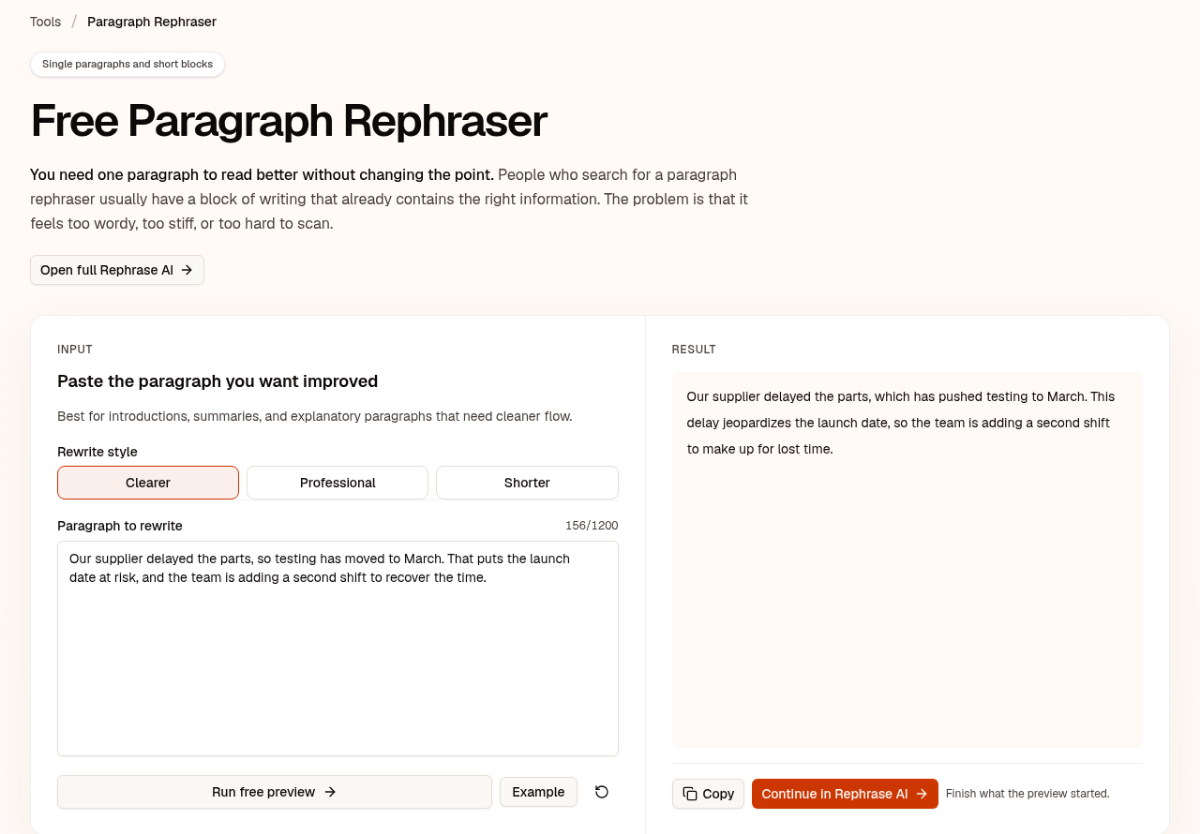
After "Our supplier delayed the parts, so testing has moved to March. That puts the launch date at risk, and the team is adding a second shift to recover the time."
The paragraph brings back the links that the list dropped. So and that put the cause and effect where readers can see them.
When you turn notes like these into prose, a paragraph rephraser can help with the joined draft. Your first attempt can run to 1,200 characters, and it returns a reworded version that stays in paragraph form for you to weigh against your own.
A last look before you publish
Read your list once from top to bottom. Check that the items match in shape, that each holds one point, and that the capitals and end marks agree. Then ask whether the list should exist at all. For documents that mix lists, prose and headings in one voice, Rephrase AI lets you pick a Professional or Casual profile so the tone holds across every format.